Transforming Complex Project Data into Strategic Decision Intelligence
Modern infrastructure and development programs operate in highly complex environments where large volumes of data must be collected, analyzed, and reported continuously. From engineering progress and contractor performance to financial disbursements, environmental safeguards, and community grievances, every project component generates critical information that must be managed systematically.
Without a structured digital platform, organizations often struggle with fragmented spreadsheets, inconsistent reporting formats, delayed decision-making, and limited transparency across project operations.
A well-designed Enterprise Management Information System (MIS) solves these challenges by integrating all project data into a unified digital ecosystem. Explore real-world implementations in the portfolio case studies.
For large infrastructure initiatives and donor-funded development programs, implementing a robust MIS is no longer optional. It is a fundamental requirement for transparency, accountability, and efficient project delivery.
The Growing Need for Digital Project Monitoring
Infrastructure development projects today involve multiple stakeholders and complex operational environments. Governments, international development organizations, consulting engineers, contractors, environmental specialists, and community representatives all contribute to project implementation.
Each stakeholder generates different types of information that must be monitored and reported regularly.
Typical project data includes:
- ✔ Construction progress reports
- ✔ Contract management data
- ✔ Financial disbursement records
- ✔ Environmental compliance monitoring
- ✔ Social safeguard documentation
- ✔ Community grievance records
- ✔ Engineering inspections and quality control reports
- ✔ Procurement documentation
- ✔ Monitoring and evaluation indicators
When this information is managed manually through emails, spreadsheets, and isolated databases, several problems quickly emerge.
Project teams spend excessive time compiling reports rather than analyzing data. Information becomes inconsistent across departments. Decision-makers lack real-time visibility into project performance. Critical issues may remain undetected until they escalate into serious risks.
An enterprise MIS eliminates these inefficiencies by creating a centralized digital platform where all project information is captured, validated, and analyzed automatically.
What an Enterprise MIS Platform Should Achieve
An effective MIS is not merely a data storage system. It functions as the operational intelligence platform of the project.
A well-designed system should deliver the following capabilities.
Centralized Data Management
All project data is stored in a structured database where it can be accessed, updated, and analyzed by authorized users. This eliminates fragmented information systems and ensures data consistency across the organization.
Real-Time Monitoring
Project managers can view progress updates, contractor performance indicators, and inspection results in real time. This allows management teams to detect delays, identify risks, and respond quickly.
Automated Reporting
MIS platforms can automatically generate progress reports, financial summaries, and performance dashboards. This reduces the time required for report preparation and improves data accuracy.
Workflow Automation
Approval processes, inspections, issue tracking, and grievance resolution can be managed through structured digital workflows. Each activity is logged and traceable.
Data Transparency
MIS systems ensure that all project activities are documented and visible to authorized stakeholders. This enhances transparency and accountability.
Decision Support
With structured data and analytical dashboards, project leadership can evaluate performance trends and make strategic decisions based on evidence rather than assumptions.
Key Modules of an Infrastructure Project MIS
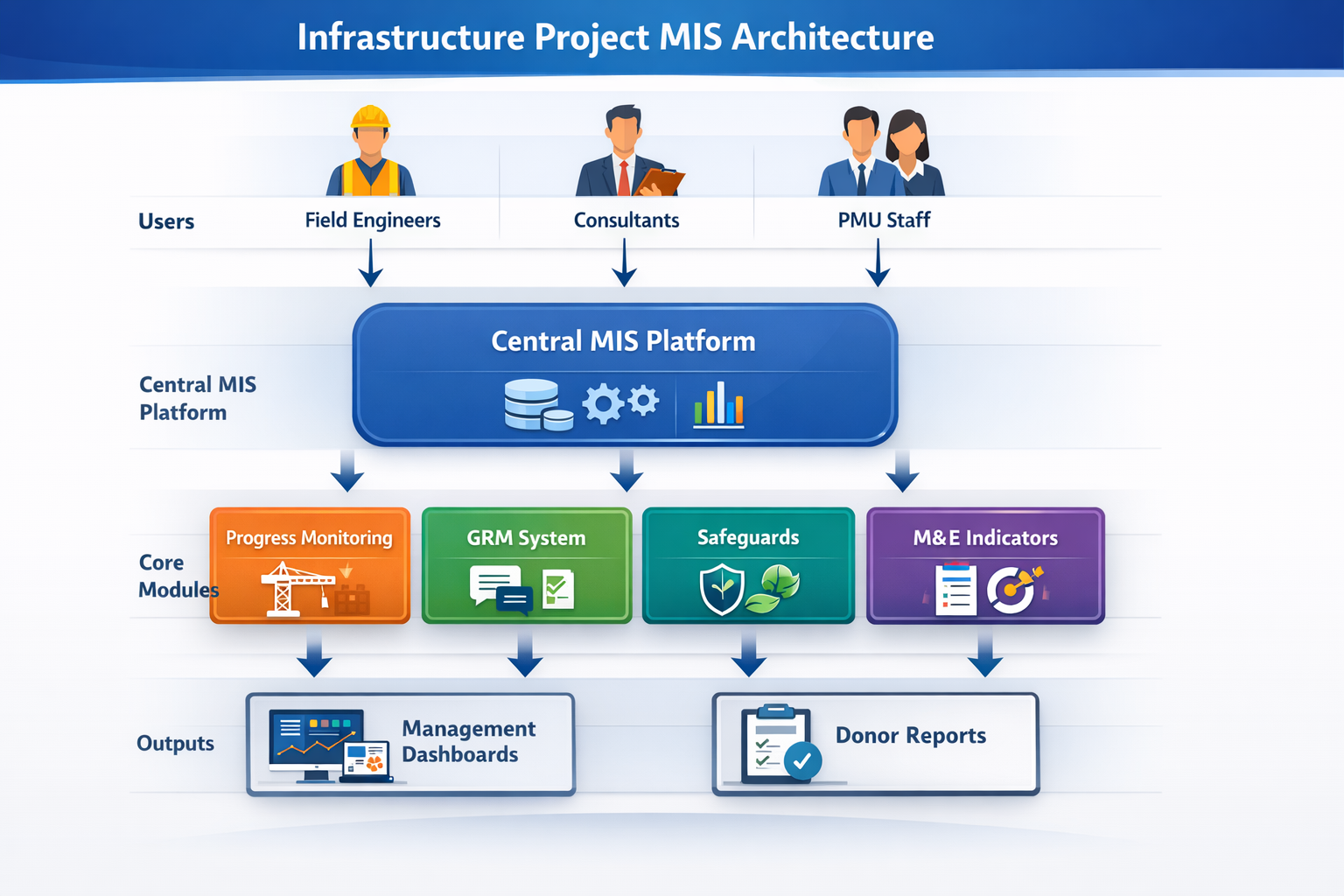
A comprehensive enterprise MIS typically includes several integrated modules designed to support different aspects of project management.
Project Monitoring Module
The project monitoring module forms the backbone of the MIS platform.
It captures field-level information related to construction progress and implementation status across multiple project sites.
Typical features include:
- Work progress tracking
- Milestone monitoring
- Contractor performance evaluation
- Site activity reports
- Schedule tracking
- Work completion verification
Project managers can quickly identify which project components are progressing according to schedule and which areas require attention.
Financial Management and Disbursement Monitoring
Infrastructure projects involve complex financial management processes including contractor payments, budget allocations, and expenditure monitoring.
An MIS financial module may track:
- Contract values and variations
- Payment certificates
- Disbursement schedules
- Financial utilization reports
- Budget comparisons
- Financial forecasting
Integrating financial data with physical progress information enables organizations to analyze whether project funds are being utilized efficiently.
Environmental and Social Safeguards Monitoring
Most donor-funded infrastructure projects must comply with strict environmental and social safeguard requirements.
An MIS can support safeguard monitoring by recording:
- Environmental inspection reports
- Safeguard compliance indicators
- Environmental incidents
- Mitigation actions
- Resettlement monitoring data
- Social impact assessments
This structured monitoring ensures compliance with international standards and strengthens project accountability.
Grievance Redress Mechanism (GRM)
Community engagement and grievance management are critical components of responsible infrastructure development.
An integrated GRM system enables organizations to manage complaints effectively by providing tools to:
- Receive and log grievances
- Register grievances from affected communities
- Categorize complaints by type
- Assign responsibility for investigation
- Monitor response timelines
- Track resolution progress
- Generate grievance statistics and reports
An effective grievance system strengthens community trust and demonstrates institutional commitment to transparency.
Inspection and Quality Assurance Module
Construction quality and safety must be monitored continuously throughout project implementation.
Inspection modules allow engineers to record field observations and monitor compliance with design specifications.
Typical features include:
- Inspection checklists
- Inspection scheduling
- Field data entry
- Photographic documentation
- Issue identification
- Corrective action tracking
- Verification of issue resolution
These tools ensure that quality standards are maintained across all project sites.
Document Management System
Infrastructure projects generate large volumes of documents including technical drawings, contracts, reports, and approvals.
A document management system allows organizations to:
- Store project documents securely
- Organize documents by project components
- Control access permissions
- Maintain version history
- Enable quick document search and retrieval
This improves document control and ensures that critical information remains accessible throughout the project lifecycle.
Dashboard and AnalyticsSenior management often requires quick and intuitive insights into project performance.
Interactive MIS dashboards can display key indicators such as:
- Project completion percentages
- Contractor performance metrics
- Financial utilization rates
- Grievance resolution statistics
- Safeguard compliance indicators
Visual dashboards transform raw data into meaningful information that supports strategic decision-making.
MIS Architecture and System Design
The long-term success of an MIS platform depends heavily on its underlying architecture. A properly designed system incorporates several technical and operational principles.
Benefits of a Well-Designed MIS
- 📊 Real-time project monitoring dashboards
- 📊 Improved transparency and accountability
- 📊 Faster donor reporting
- 📊 Better coordination between stakeholders
- 📊 Improved grievance management
- 📊 Data-driven decision making
Challenges in MIS Implementation
Different project stakeholders require different levels of system access.
Typical user roles may include:
- System administrators
- Project managers
- Field engineers
- Financial officers
- Environmental specialists
- Contractors
- Donor representatives
Role-Based User Management
Role-based permissions ensure that each user can access only the data relevant to their responsibilities. Typical user roles may include:
- System administrators
- Project managers
- Field engineers
- Financial officers
- Environmental specialists
- Contractors
- Donor representatives
Role-based permissions ensure that each user can access only the data relevant to their responsibilities.
Structured Database Design
A well-designed relational database ensures that project data remains organized and scalable.
Key considerations include:
- Logical data relationships
- Minimized data duplication
- Efficient reporting queries
- Optimized system performance
Database architecture forms the backbone of any enterprise MIS platform.
Structured Database Design
A well-designed relational database ensures that project data remains organized and scalable.
Key considerations include:
- Logical data relationships
- Minimized data duplication
- Efficient reporting queries
- Optimized system performance
Database architecture forms the backbone of any enterprise MIS platform.
Web-Based Accessibility
Modern MIS systems are typically web-based applications that allow users to access the platform through secure internet connections.
This enables:
- Remote field reporting
- Centralized monitoring
- Multi-location collaboration
- Faster information sharing
Web-based platforms significantly improve operational efficiency.
Technology Stack for Modern MIS Platforms
Enterprise MIS systems are typically built using modern and scalable technologies.
Typical technology stacks include:
Backend frameworks
Python, Django, Django Rest Framework
Frontend technologies
React, Vue.js, Bootstrap UI frameworks
Database systems
PostgreSQL, MySQL, Microsoft SQL Server
Cloud infrastructure
Secure hosting environments, Automated backups, Scalable server architecture
Selecting the appropriate technology stack ensures system reliability and long-term maintainability.
Benefits of Enterprise MIS Implementation
Organizations that implement integrated MIS platforms experience significant improvements in project management efficiency.
Key benefits include:
Improved Project Oversight
Management teams gain comprehensive visibility into project operations.
Faster Decision Making
Issues can be detected early and addressed before they escalate.
Better Donor Reporting
Structured data simplifies preparation of reports for development partners.
Increased Transparency
Project information becomes traceable and accessible.
Institutional Knowledge Development
Historical project data becomes a valuable resource for future programs.
Digital Transformation in Infrastructure Project Management
As infrastructure investments expand globally, the complexity of project management continues to increase.
Organizations that rely solely on traditional reporting methods face growing challenges in maintaining efficiency and transparency.
Enterprise MIS platforms provide the digital foundation needed to manage large-scale programs effectively.
By integrating data collection, monitoring, reporting, and analytics into a unified platform, organizations can significantly strengthen their project management capabilities.
Strategic Value of MIS Consulting
Designing and implementing an effective MIS requires both technical expertise and a deep understanding of project management processes.
MIS consulting services help organizations analyze operational workflows, design system architecture, and develop scalable digital platforms. Learn more about my MIS consulting services and how organizations implement enterprise MIS platforms for infrastructure and donor-funded projects.
- Analyze their operational workflows
- Design appropriate system architecture
- Develop scalable digital platforms
- Improve data management practices
- Strengthen project monitoring frameworks
With the right expertise, organizations can transform complex project data into actionable insights that improve both project performance and institutional capacity.
Building Smarter Project Management Systems
Infrastructure and development programs represent significant public investments. Ensuring that these investments deliver their intended benefits requires strong monitoring systems, transparent reporting mechanisms, and reliable data management practices.
Enterprise MIS platforms provide the digital infrastructure necessary to achieve these objectives.
By integrating operational data, financial management, safeguard monitoring, and community engagement into a unified system, organizations can build more efficient, accountable, and responsive project management environments.
As development projects continue to grow in scale and complexity, the importance of intelligent digital management systems will only increase.
Organizations that invest in robust MIS platforms today position themselves for stronger governance, better decision-making, and more successful project outcomes in the future.
Contact for MIS Consulting and System Development
Organizations seeking to implement enterprise MIS platforms for infrastructure, hydropower, and donor-funded projects can benefit from tailored system design, workflow automation, and compliance-driven reporting solutions.